Applying precision irrigation solutions to optimise water management can prove to be a key factor in responding to the abnormal temperatures recorded across Italy at the beginning of this summer.
Managing water correctly in agriculture does not mean irrigating less, but applying the right amount at the most appropriate time, based on the crop’s actual needs. The data are clear: according to Istat, in 2024 more than 90% of Italian farms reported irrigation difficulties; this share reached 97.5% in Southern Italy and 98.8% in the Islands.
In this context, precision irrigation and Decision Support Systems can help farmers and technicians schedule interventions based on up-to-date data, reducing the risk of excess water, water shortages and inefficient operations.
Applying precision irrigation solutions to optimise water management can prove to be a key factor in responding to the abnormal temperatures recorded across Italy at the beginning of this summer.

Managing water correctly in agriculture does not mean irrigating less, but applying the right amount at the most appropriate time, based on the crop’s actual needs. The data are clear: according to Istat, in 2024 more than 90% of Italian farms reported irrigation difficulties; this share reached 97.5% in Southern Italy and 98.8% in the Islands.
In this context, precision irrigation and Decision Support Systems can help farmers and technicians schedule interventions based on up-to-date data, reducing the risk of excess water, water shortages and inefficient operations.

What precision irrigation is
Precision irrigation makes it possible to determine when to irrigate and how much water to apply, taking into account the specific conditions of each plot.
 Crop water requirements are not constant throughout the season, but vary according to several factors:
- crop and phenological stage
- soil characteristics and texture
- root system depth
- temperatures and weather conditions
- recorded and forecast rainfall
- evapotranspiration
- irrigation operations already carried out
Irrigating exclusively according to a fixed schedule may lead to applying water when it is not needed or, conversely, intervening too late, when the crop is already entering a state of stress.
The aim of precision irrigation is to transform weather, agronomic and crop data into operational recommendations, without replacing the farmer’s experience, but rather supporting it.
Precision irrigation makes it possible to determine when to irrigate and how much water to apply, taking into account the specific conditions of each plot.
Crop water requirements are not constant throughout the season, but vary according to several factors:
- crop and phenological stage
- soil characteristics and texture
- root system depth
- temperatures and weather conditions
- recorded and forecast rainfall
- evapotranspiration
- irrigation operations already carried out
Irrigating exclusively according to a fixed schedule may lead to applying water when it is not needed or, conversely, intervening too late, when the crop is already entering a state of stress.
The aim of precision irrigation is to transform weather, agronomic and crop data into operational recommendations, without replacing the farmer’s experience, but rather supporting it.
Why the water balance is important
One of the tools used to schedule irrigation is the soil water balance, which compares water inputs – such as rainfall and irrigation – with losses mainly due to crop evapotranspiration.
The soil’s ability to make water available to the roots also depends on its texture: a soil can retain water up to field capacity; as the soil dries, water becomes increasingly difficult for the crop to absorb. Once a given threshold is exceeded, the crop may start to show signs of water stress.

FAO methodologies for calculating crop water requirements consider the relationship between reference evapotranspiration, crop coefficients, development stage and water availability conditions. Monitoring these elements daily makes it possible to identify the most suitable time to irrigate, avoiding both water deficit and applications that exceed the soil’s water-holding capacity.
Agricolus irrigation model
With Agricolus, users can consult weather forecasts associated with individual fields and use data from weather stations installed in the plots. These data, together with soil characteristics, the crop grown and the recorded irrigation operations, feed the irrigation forecasting model.
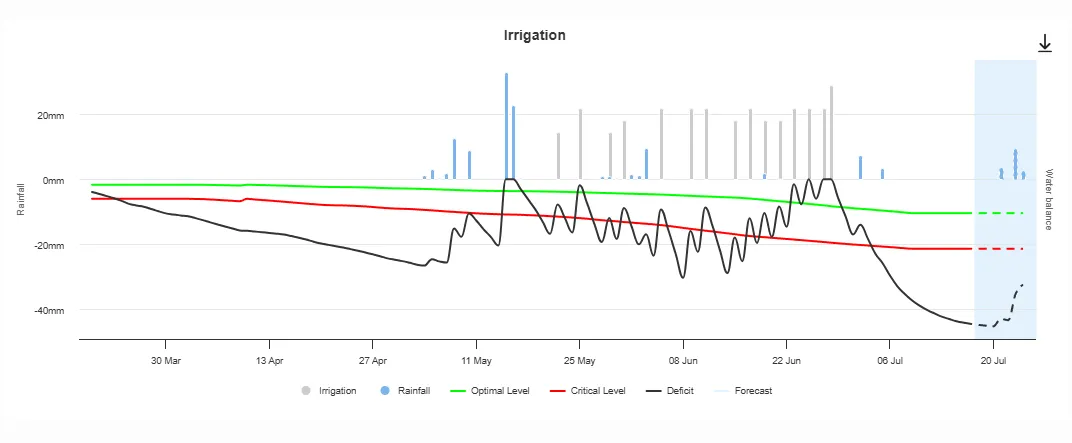
Agricolus Irrigation Model Chart
The model processes a water balance that takes several parameters into account, such as soil texture, rainfall and the crop grown, to provide a recommendation on when and how much to irrigate. It is fed by rainfall data and recorded irrigation operations, and provides constant updates on the values of the water deficit curve, which corresponds to the amount of water missing compared to field capacity.
There are also two additional reference curves: the optimal threshold, which is the deficit level below which the crop begins to experience stress, and the critical threshold, also known as the wilting point, which represents the final limit for avoiding severe water stress damage.
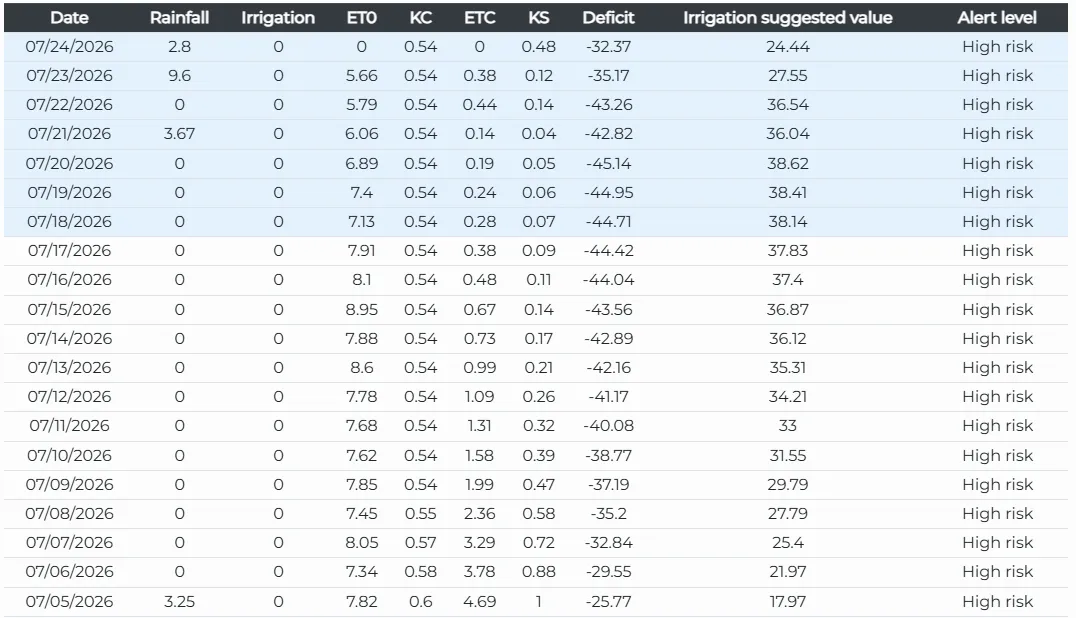
Table with daily evapotranspiration and water deficit data from the Agricolus irrigation model
The model alerts the farmer when the deficit drops below the optimal threshold, indicating the amount of water to apply. In addition, users can consult the table showing evapotranspiration and water deficit data on a daily basis, in order to plan irrigation operations according to their needs.
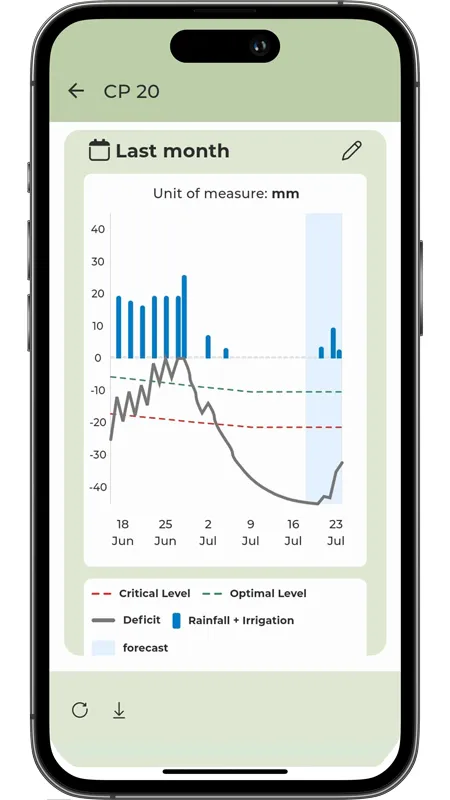
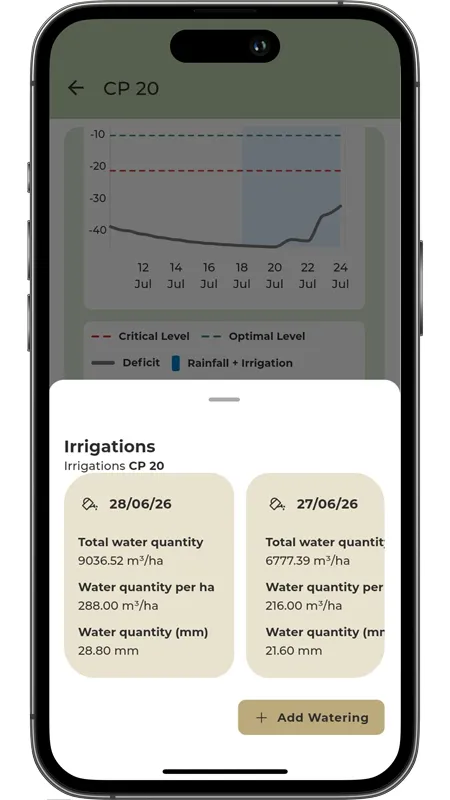
The system therefore does not provide a standard recommendation that is valid for every field, but rather generates a suggestion based on the specific characteristics of the plot and the observed weather conditions.