Wheat powdery mildew, caused by the fungus Blumeria graminis f. sp. tritici (syn. Erysiphe graminis), represents one of the main foliar diseases of autumn-winter cereals. Under favorable conditions, it can lead to significant yield reductions, especially in susceptible varieties and during years characterized by a mild and dry climate.
Alongside traditional defense strategies, decision support technologies are playing an increasingly important role, particularly forecast models, which allow for a more rational and sustainable management of fungicide applications.

What are the symptoms of wheat powdery mildew
Wheat powdery mildew develops on the surface of the plant’s green organs. Initial symptoms appear as whitish powdery spots on leaves, leaf sheaths, and, in the most severe cases, also on the culm and spike.
As the infection progresses, the fungal colonies tend to become more compact and grayish, with the appearance of cleistothecia, resistance organs that allow the pathogen to survive the unfavorable season.
The most affected leaves are generally the basal ones, but under high disease pressure, the infection can move up to the flag leaf, directly compromising photosynthesis and the final yield.
Wheat powdery mildew develops on the surface of the plant’s green organs. Initial symptoms appear as whitish powdery spots on leaves, leaf sheaths, and, in the most severe cases, also on the culm and spike.
As the infection progresses, the fungal colonies tend to become more compact and grayish, with the appearance of cleistothecia, resistance organs that allow the pathogen to survive the unfavorable season.

Photo credits: wiki.bugwoodcloud.org
The most affected leaves are generally the basal ones, but under high disease pressure, the infection can move up to the flag leaf, directly compromising photosynthesis and the final yield.
Photo credits: wiki.bugwoodcloud.org
Environmental conditions favorable to development
Unlike many other fungal diseases, wheat powdery mildew does not require rain to develop. The optimal conditions for its spread are:
- mild temperatures, generally between 10 and 20 °C
- high relative humidity, even in the absence of precipitation
- dense crops and excessive nitrogen fertilization
- during the infectious process, it prefers higher temperatures (up to 30 degrees).
Mild winters and dry springs favor early infections, starting as early as the tillering stage, with subsequent intensification of the disease during stem elongation. In these cases, powdery mildew can remain active for long periods, increasing the risk of economic damage.
The 2024-2025 season was characterized by an extremely variable climate. In the North and Center of Italy, heavy spring rains caused waterlogging, and the high humidity during the stem elongation phase favored the development of the fungus at the base of the culms and on the lower leaves. In the South and Islands, the mild winter led to an early appearance of the pathogen: the greatest risk was detected in fields with high sowing density, which created a humid and closed microclimate within the canopy.
Unlike many other fungal diseases, wheat powdery mildew does not require rain to develop. The optimal conditions for its spread are:
- mild temperatures, generally between 10 and 20 °C
- high relative humidity, even in the absence of precipitation
- dense crops and excessive nitrogen fertilization
- during the infectious process, it prefers higher temperatures (up to 30 degrees).
Mild winters and dry springs favor early infections, starting as early as the tillering stage, with subsequent intensification of the disease during stem elongation. In these cases, powdery mildew can remain active for long periods, increasing the risk of economic damage.

The 2024-2025 season was characterized by an extremely variable climate. In the North and Center of Italy, heavy spring rains caused waterlogging, and the high humidity during the stem elongation phase favored the development of the fungus at the base of the culms and on the lower leaves. In the South and Islands, the mild winter led to an early appearance of the pathogen: the greatest risk was detected in fields with high sowing density, which created a humid and closed microclimate within the canopy.
Monitoring and intervention thresholds
 Defense against wheat powdery mildew is based primarily on careful field monitoring, especially between tillering and the start of stem elongation, phases considered critical for the onset of the epidemic.
According to the guidelines of regional phytosanitary services and integrated defense protocols, chemical intervention is justified when the infection is present on a significant percentage of plants and tends to move toward the upper leaves.
Near the emergence of the flag leaf, the decision to treat must be even more targeted, evaluating the actual activity of the disease and the risk of yield damage, often in competition with other foliar pathologies such as septoria (Zymoseptoria tritici) and rusts (Puccinia striiformis).
Defense against wheat powdery mildew is based primarily on careful field monitoring, especially between tillering and the start of stem elongation, phases considered critical for the onset of the epidemic.
According to the guidelines of regional phytosanitary services and integrated defense protocols, chemical intervention is justified when the infection is present on a significant percentage of plants and tends to move toward the upper leaves.
Near the emergence of the flag leaf, the decision to treat must be even more targeted, evaluating the actual activity of the disease and the risk of yield damage, often in competition with other foliar pathologies such as septoria (Zymoseptoria tritici) and rusts (Puccinia striiformis).
Defense strategies against wheat powdery mildew
From the traditional approach to integrated pest management
The fight against wheat powdery mildew is now part of a context of integrated defense, which combines:
- correct agronomic choices (rotations, sowing density, nitrogen management)
- use of tolerant or less susceptible varieties
- rational use of fungicides, with specific active ingredients and diversified modes of action.
The goal is not the eradication of the disease, but the containment of its intensity below the economic damage threshold, minimizing the environmental impact of the interventions.

The role of forecast models
In recent years, research and experimentation have led to the development of forecast defense models for wheat powdery mildew, based on the processing of meteorological data (temperature, humidity, seasonal trends) and the phenological stage of the crop, which allow to:
- estimate the infection risk
- identify the most critical time windows for disease development
- support the farmer in choosing the optimal moment for intervention.
These tools allow for a transition from “calendar-based” defense to a truly risk-guided defense, with economic and environmental benefits.
How the wheat powdery mildew defense model works
The forecast model for wheat powdery mildew that we will shortly release in Agricolus is based on a mechanistic approach, which aims to simulate the infection process of the pathogen as a function of weather conditions and the phenological stage of the crop.
When environmental conditions favorable to infection occur, the model starts calculating the effective infection efficiency, expressed as a percentage value, which is associated with a specific risk class. This output allows for the evaluation of not only the presence of predisposing conditions but the actual ability of the fungus to establish the infection.
A distinctive element of the model is the dynamic evaluation of spore survival, which can decrease in certain intervals of average temperature, vapor pressure, and precipitation, contributing to a more realistic risk estimate.
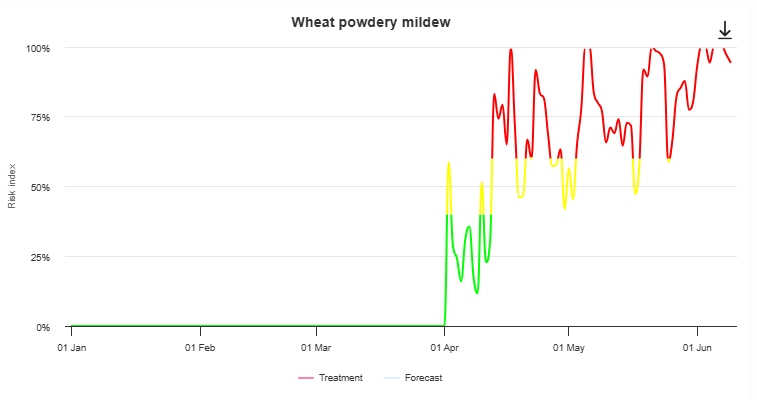
Graph of the forecasting model for powdery mildew in wheat from the Agricolus platform
The operational advice is returned to the farmer only after the BBCH 31 phenological stage (start of stem elongation) has been passed, to avoid premature alerts at times when field intervention is not yet justified.
Working steps of the Agricolus defense model for powdery mildew in wheat
1 |
2 |
3 |
4 |
|---|---|---|---|
|
|
|
|
|
| Mechanistic simulation of the pathogen | Calculation of effective infectious efficiency | Dynamic spore monitoring | Operational advice after BBCH phase 31 |


Using the predictive model for the defense against wheat powdery mildew offers numerous advantages:
- reduction of unnecessary treatments, with lower production costs
- better efficacy of interventions, carried out at the moment of maximum crop sensitivity
- contribution to the sustainability of cereal farming, in line with the objectives of integrated defense and European policies
- decision support even in contexts of increasing climate variability.
Wheat powdery mildew remains a phytopathology of great agronomic relevance. In-depth knowledge of the pathogen’s biology, predisposing conditions, and the most sensitive phenological stages represents the basis for an effective defense.
In this context, Decision Support Systems (DSS) constitute a key tool for a modern and sustainable management of the disease, capable of combining productivity, reduction of chemical inputs, and environmental protection.