

Warehouse management is a key activity for every farm: knowing how much product is available, tracking purchases and registering consumption helps organise work more effectively, avoid waste and keep production costs under control.
As the sector becomes increasingly digitalised, this information takes on even greater importance. The introduction of the digital field register requires increasingly accurate management of data relating to crop operations.
To meet these needs, Agricolus introduces the Warehouse feature, which makes it possible to monitor farm inventory, register incoming and outgoing stock movements, and link the use of agricultural inputs to agronomic operations.
The aim is to provide a complete view of the production process, from purchasing products to their use, through to harvest and production lot verification.
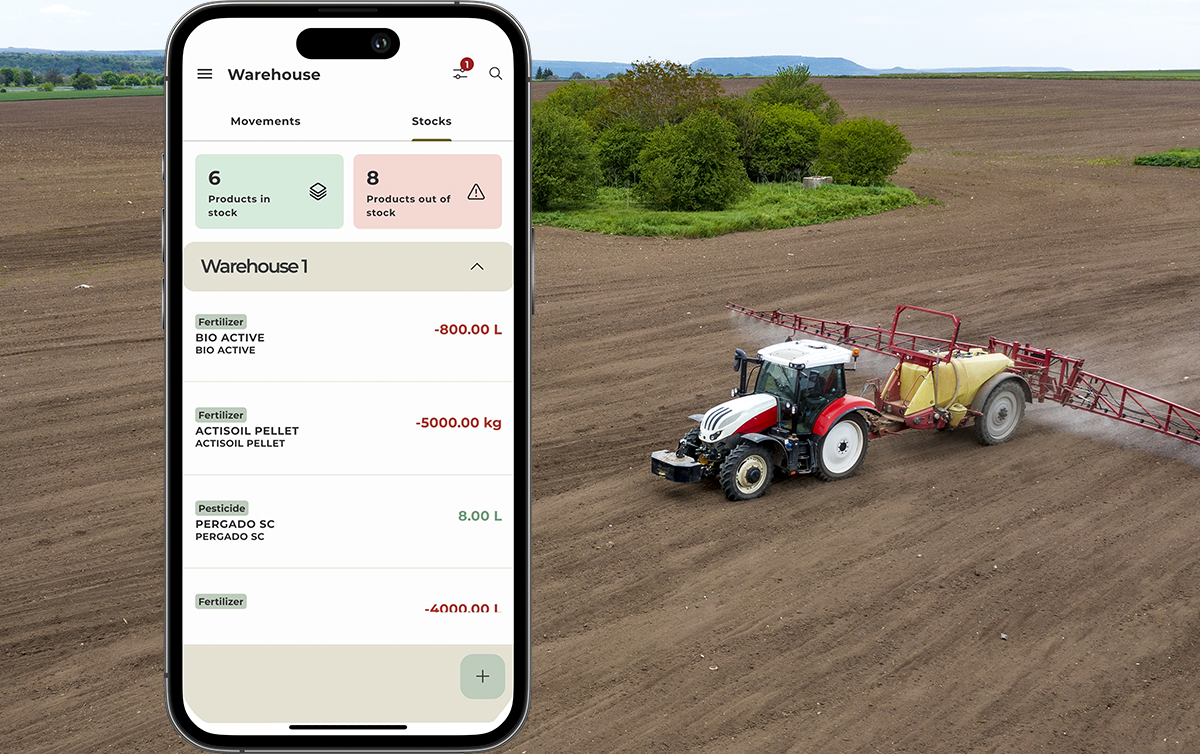
From the digital field register to the warehouse: an integrated system
Registering field activities digitally is an important step, but efficient farm management also requires an understanding of how product use affects available inventory.
The integration between the operations register and the digital warehouse connects these two dimensions, preventing agronomic information and stock data from being managed separately.
In this way, each product purchase corresponds to a registered incoming stock movement. Subsequently, using the product in a completed crop operation can generate the corresponding outgoing movement, updating the remaining quantity available.

The benefit goes beyond register compilation and also includes:
- monitoring inventory, knowing the quantities available and highlighting out-of-stock products.
- reducing duplicate data entry, linking consumption to agronomic activities.
- supporting purchasing, identifying materials that need to be replenished before new operations.
- controlling costs, associating the available economic information with stock movements.
- organising suppliers and recipients, keeping their details in one place.
How warehouse management works in Agricolus
The new Agricolus Warehouse feature makes it possible to organise farm materials and monitor their movements. It includes warehouse management, the product catalogue, stock movement registration and inventory viewing. All this information is summarised in an operational dashboard, which provides key indicators on the number of warehouses, available products and out-of-stock items, together with the latest registered movements.
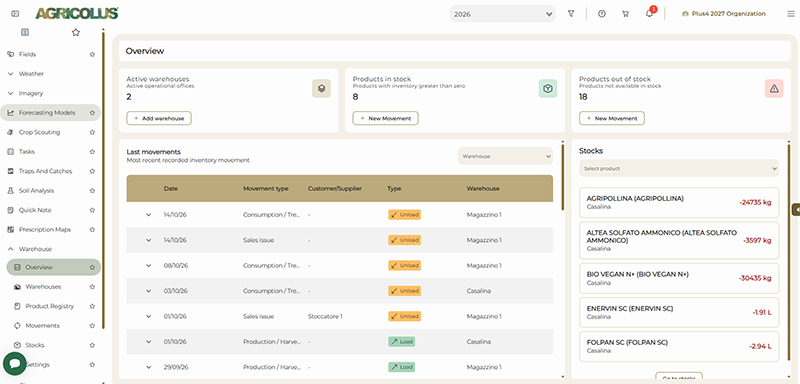
Agricolus - warehouse overview
Farmers can therefore quickly identify the most relevant information without having to check each movement separately.
Organising one or more farm warehouses
Every farm may have different storage locations: with Agricolus, it is possible to create and manage multiple warehouses, assigning each one a name, a site reference and, where needed, additional identifying notes.
This organisation makes it possible to distribute materials across multiple locations while maintaining an overall view of farm resources.
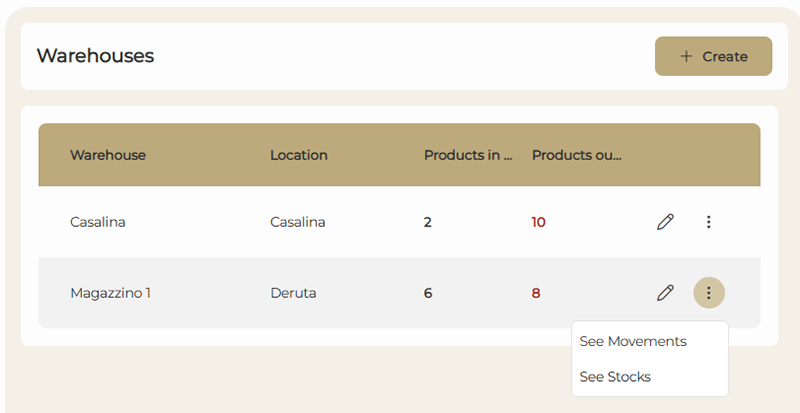
Agricolus - warehouses list
Product catalogue
The product catalogue provides a list of the materials used on the farm, to which incoming and outgoing stock movements can be linked.
Alongside the personal list, where users add items and the related information themselves, the BDF catalogue provides a list of registered agricultural inputs together with their label information. It is updated daily to remain aligned with products available on the market.
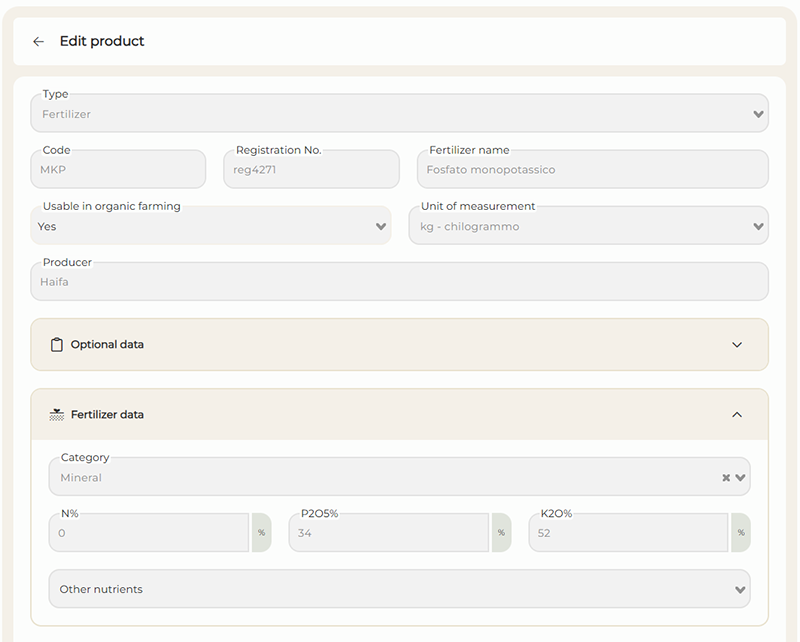
Agricolus - Warehouse feature - product sheet
The system distinguishes between several item categories:
- plant protection products
- fertilisers
- seeds
- seedlings for transplanting
- stored produce
Items can also be searched using filters by name, category, type or crop, making the catalogue easier to browse.
Incoming and outgoing stock movements: keeping purchases and consumption under control
Managing stock movements is the operational core of the digital warehouse. With Agricolus, you can register incoming movements, which increase the quantities available, and outgoing movements, which reduce them.
An incoming movement may represent, for example, the receipt of a new supply of fertilisers. An outgoing movement may instead be associated with the sale of harvested produce or with the use of a product during a treatment.

The Activities and Production Lots functions are closely linked to this section of the warehouse:
- in the first, you can manage the register of crop operations, which are directly linked to warehouse movements, so that every treatment, sowing or fertilisation operation is translated into an outgoing movement.
- with Production Lots, you can manage the traceability of agricultural produce. Each lot is associated with its own QR code, giving stakeholders across the supply chain access to all cultivation data available on the platform. When a lot is closed, the harvested quantity is automatically added to the selected warehouse.
In this way, farmers do not have to manage two independent entries, saving time and reducing the risk of inconsistencies.
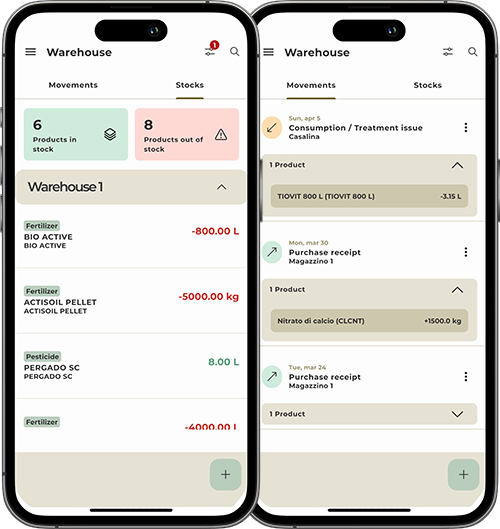
Each movement includes information such as the date, warehouse concerned, reason, reference document, supplier or recipient, and quantities of the products involved.
Additional data can also be entered, such as unit cost or price, VAT rate in the relevant documents, lot code and expiry date. For sales movements, the app automatically generates the transport document as a PDF.
This information provides a history of incoming and outgoing stock movements, creating a useful basis for analysing costs incurred and commercial relationships with the different parties involved.
Up-to-date inventory and out-of-stock products

Knowing how much product is in storage is essential for planning agronomic activities correctly. The Inventory section allows users to view the available quantities for each item, broken down by warehouse.
Availability is calculated from the difference between registered incoming and outgoing movements: if an entry is modified or corrected, the displayed inventory level reflects the change automatically, without requiring a separate manual update.
Out-of-stock items or items with non-positive availability are highlighted, making it easy to identify situations requiring attention. For example, before planning a fertilisation operation, users can check the amount of fertiliser available and assess whether a new purchase is needed.
Knowing how much product is in storage is essential for planning agronomic activities correctly. The Inventory section allows users to view the available quantities for each item, broken down by warehouse.
Availability is calculated from the difference between registered incoming and outgoing movements: if an entry is modified or corrected, the displayed inventory level reflects the change automatically, without requiring a separate manual update.

Out-of-stock items or items with non-positive availability are highlighted, making it easy to identify situations requiring attention. For example, before planning a fertilisation operation, users can check the amount of fertiliser available and assess whether a new purchase is needed.
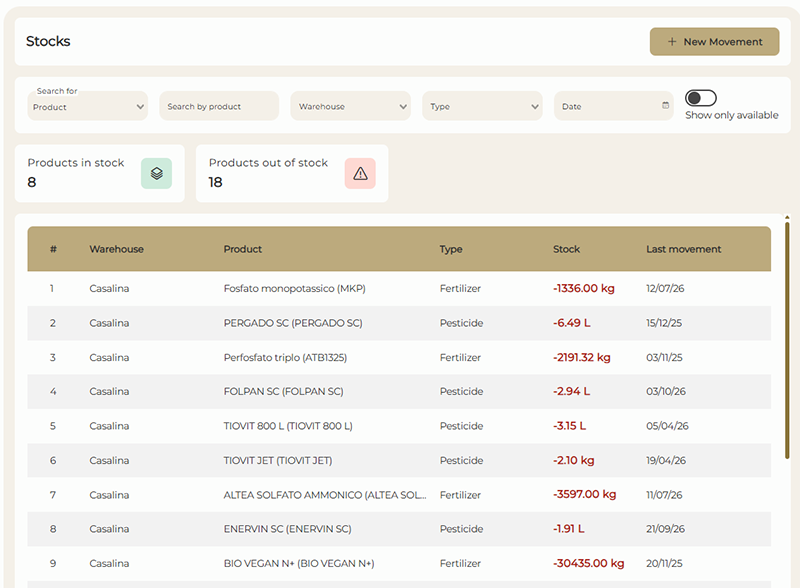
Agricolus - Warehouse feature - stocks
With the Warehouse feature, Agricolus expands the ways farms can coordinate their operations by connecting product availability, field activities and production-process documentation.


