One of the most critical aspects of the agricultural system is communication between advisors and farms: in other words, the transition from information to concrete action in the field.
The new Alerts feature developed by Agricolus fits precisely into this context, introducing a structured system for operational communication. Its most innovative element is the integration with WhatsApp, which enables notifications to be sent directly to farmers.
In this article, we will analyse the context in which this feature was created and the benefits it provides.

Crop protection and production protocol management: the need for support
Farms operate in a particularly complex technical and regulatory context, in which crop protection can no longer rely on individual actions or experience alone, but requires continuous, tailored technical support.

The most important challenges in agricultural production are:
- compliance with production protocols, environmental constraints and the quality standards required by the supply chain, which are becoming increasingly stringent.
- the complexity arising from the number of solutions available: in Italy, there are over 17,000 plant protection products registered as authorised, suspended or revoked, each with specific conditions of use.
- the need to correctly choose not only the product, but also the timing and method of application, avoiding mistakes that may have technical, economic and regulatory impacts.
Today, crop protection strategies are undergoing a major evolution. Data show that the use of plant protection products is progressively decreasing: in Italy, approximately 40,000 tonnes of active substances were distributed in 2023, with a significant decline compared with previous years and a reduction in the amount per hectare from 3.6 to 3.2 kg/ha. This trend reflects the regulatory and technical pressure towards more sustainable and targeted crop protection.

Against this backdrop, the farmer’s main need is not simply to access generic information, but to rely on targeted decision support provided by advisors who can connect data, production protocol requirements and agronomic recommendations, translating them into rational field operations aligned with the relevant guidelines.
Crop protection management therefore becomes a complex process that requires coordination, timeliness and precision, and is difficult to manage without structured tools.
The evolution of technical assistance and the development of bulletins

Technical assistance in agriculture has evolved over time, adapting to changes in the sector and to the growing complexity of farm management. Initially, the model was mainly indirect and based on guidance disseminated at territorial level, often with little differentiation between farms.
Subsequently, with the development of guided crop protection and organised technical assistance, a model emerged based on a strong presence of advisors in the field, able to support individual farms directly. This approach delivered excellent results in terms of effectiveness, but proved difficult to sustain over time, especially as the number of farms to be managed increased.
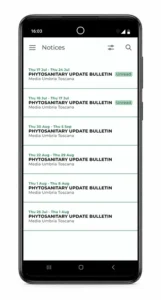
Over the years, the system has therefore moved towards a reduction in the direct advisor–farm relationship, while maintaining the technical reference point and introducing more scalable operating methods. As a result, technical bulletins and forecasting services have become key tools for transferring agronomic guidance to a large number of farms, ensuring consistency with production protocols and uniformity in practices.
The current model can be described as “direct technical assistance through indirect methods”, in which the advisor no longer acts only in the field, but coordinates and guides decisions through structured communication tools.
What is the role of digitalisation in today’s technical assistance?
The spread of indirect assistance models has made it essential to use technologies capable of ensuring effectiveness and continuity in information management.
Technical work today relies on a complex set of supports, including meteorological data, forecasting models, databases, and tools for analysing production protocols and farm information. The large volume of data generated requires a system capable of integrating them and making them operational.
Digital platforms therefore play a central role: not only in collecting and organising information, but above all in enabling it to be transformed into concrete recommendations and in managing communication with farms. In a context where field visits are decreasing and the number of farms to support is increasing, the ability to use digital tools becomes essential to maintain high levels of effectiveness.

Digitalisation is therefore not only a technological evolution, but a structural element in technical assistance practices, making it possible to:
- connect and make different data sources accessible
- support agronomic prescriptions and farm decisions
- facilitate the flow of information between advisor and farm, improving operational management
The “Alerts” feature in AgriTrack
In line with the need expressed by many professionals to efficiently share technical information with farmers, we have developed the Alerts feature within AgriTrack.
This is a module dedicated to the structured management of agronomic communication, allowing advisors to:
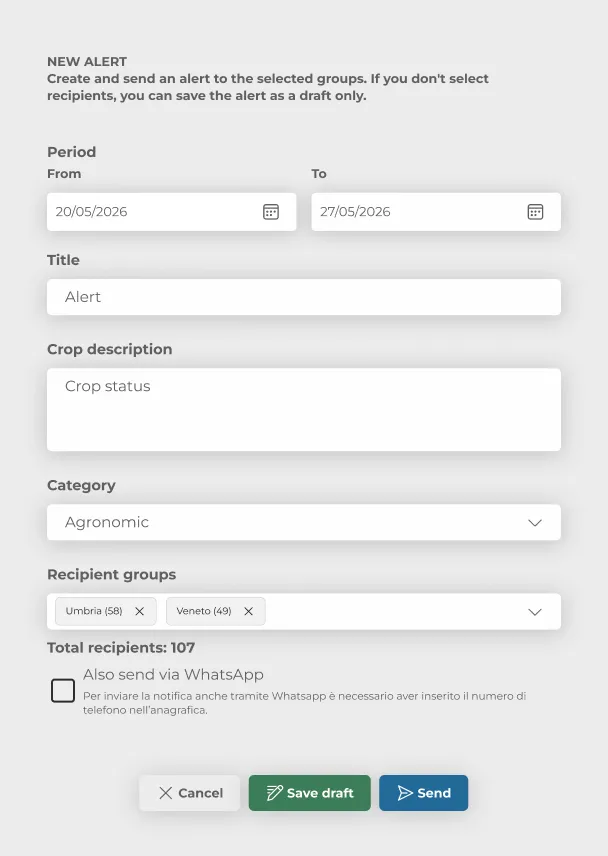
- create alerts and technical bulletins
- define recipient groups (divided by area, crop or farm)
- send targeted communications
- monitor the status of deliveries and views
- export data on interactions
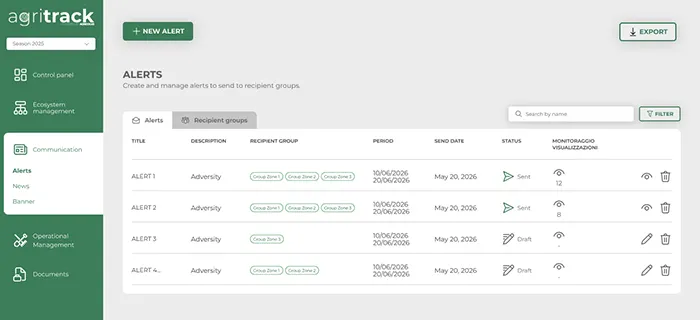
AgriTrack Platform - alert list
Compared with traditional forms of communication such as phone calls or messages, the feature represents an evolution and an improvement in the efficiency of technical activities, introducing traceability, organisation and measurability of information.
Alerts can be used for different operational purposes:
- communicating crop protection bulletins
- reporting risks (weather, pathogens, water stress)
- sending reminders for field activities
A key element is the management of recipient groups, which makes it possible to deliver content adapted to specific territorial or production conditions, improving the precision of the technical intervention.
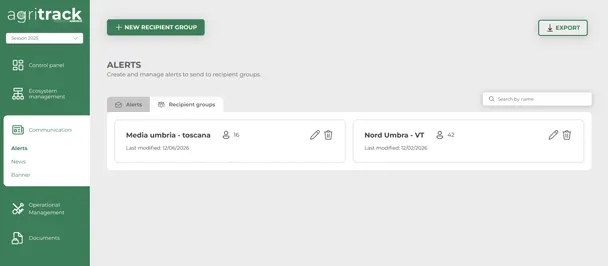
AgriTrack platform - ability to create recipient groups for alerts
Sending notifications via WhatsApp: the real innovation
Within the Alerts feature, the integration with WhatsApp is the main distinguishing element: the system can send notifications to farmers through this channel, informing them that new bulletins or communications are available.
The widespread use of WhatsApp makes the information sent easy for recipients to view.
The process for sending bulletins via WhatsApp is simple: the advisor creates an alert in AgriTrack, selects the recipients, also enables delivery via WhatsApp, and farmers receive a notification on their device informing them that a new bulletin is available, which can then be consulted directly from the Agricolus app.
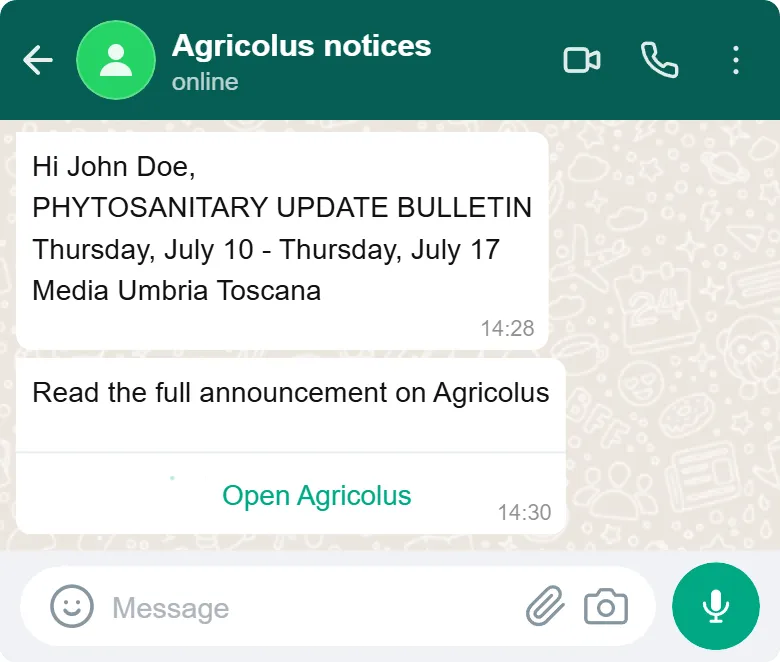
The benefits are numerous:
- greater communication effectiveness: the likelihood that a message will be read increases significantly. This is particularly important in situations requiring timely interventions, such as crop protection treatments, irrigation management and climate-related emergencies.
- reduction of operational risk: many mistakes in agriculture result from information not being received or from communication delays. Immediate notification reduces these critical issues, improving the quality of operations.
- digital inclusion: the use of WhatsApp makes the system accessible even to small farms and operators with limited digital skills.
- scalability of agronomic consultancy: an advisor can send communications to a large number of farms in a short time, while maintaining a high level of quality. This makes it possible to increase efficiency, reduce costs and improve the service provided.
Integration with the other AgriTrack features
The Alerts feature integrates with all the other features available in AgriTrack: through the platform, it is possible to view farm data in a single interface, manage supply chain traceability, coordinate agricultural activities, use DSS and satellite imagery for territorial and tailored agronomic consultancy, and manage the field logbooks of associated or supplying farms.
The use of AgriTrack therefore makes it possible to create a virtuous cycle that ensures consistency and continuity of information across the different stages of the agri-food supply chain, increasing production efficiency, food safety and regulatory compliance.